Marge: Homer, he prefers the company of men.
Homer: Who doesn't?
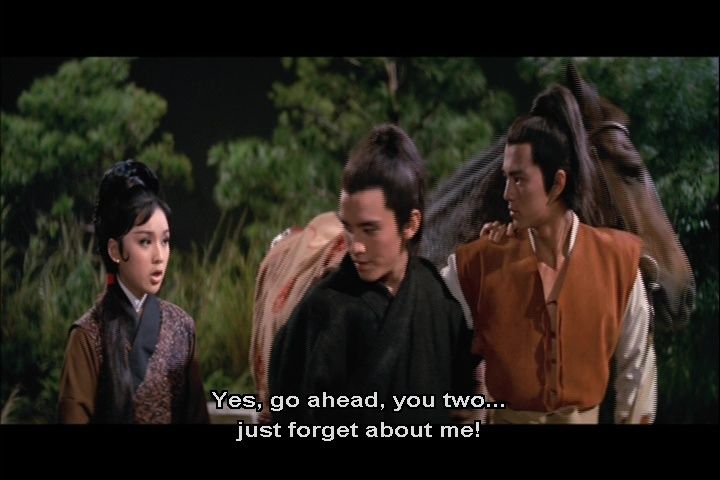 The New One-Armed Swordsman (1971: Chang Cheh: Hong Kong):
Considering how much I like this, how little I have read about it, how few (if any) canonical lists it is on, I would consider this an underrated gem in the oeuvre of Chang Cheh. While I will have to ponder more on how I think it compares to the previous two One-Armed films from Chang Cheh (
The One-Armed Swordsman,
Return of the One-Armed Swordsman) I thought this was a blast and a worthy and last entry in the Shaw’s one-armed films (the character would continue elsewhere).*
The production values of this is sublime with beautiful sets and one of the best directing efforts in terms of cinematography I have seen from Chang Cheh and cinematographer Kung Mu-tu (aka Yukio Miyaki). There is plenty of deep focus, beautiful composition that makes full use of the sets, foreground, dolly movements and complicated set-ups.
This fits nicely in Chang Cheh’s output as it focuses on male heroes (using the Iron Triangle of David Chiang, Ti Lung and Cheh), homosocial bonding, homoerotic content, revenge, Peckinpah-ish slow-motion and lots of blood lust. The martial arts scenes come off nicely here as well. I am not always fond (or else like with Tom Cruise my opinion of him has increased over the years) of David Chiang but he comes off well here. He is more athletic than the previous Jimmy Wang Yu, though Yu does have a different type of panache that can play pathos well, though lacks the impishness that Chiang has.
I do think more could have been made about Lei Li (David Chiang) improving his martial art abilities. He started off as a badass and ended as a badass with no obligatory training scenes for the one-armed-ness. Though it is interesting how both Hero Fung (Ti Lung) and Lei found out the secret to winning completely separate from each other (though Lei did have a much longer time to figure it out – he must have been contemplating it over the years.) I was a little annoyed by Fung not wanting to know Long Er-zi’s secret. His steadfastness in thinking he was not going to fight him was a bit annoying (one would think any decent martial artist would want all information as possible before going into any situation.) But I had so much fun with this film I could easily watch it again, recommend it to other fans of martial art movies (who have not seen this) and wonder why Chang Cheh is not known as well as he should be.
One reason it took me so long to watch this was that it was never released here. I just happened upon a used R3 version (Deltamac from Taiwan; I had to watch this on my computer) that appears to be exactly the same as the R3 IVL version. This really should have a BD/DVD release here in the States.
* Dr. Craig D. Reid had this to say in his
The Ultimate Guide to Martial Arts Movies of the 1970s: “I once asked Jimmy Wong Yu how he thought these films changed over the years. He shared that
One-Armed Swordsman emphasized setting up the background story;
Return devoted more time to the interrelationships of the characters, and more tricks were shown via weaponry and kung fu skills; and
The New One-Armed Swordsman put more emphasis on the production, with many grand scenes.” I do wish in his capsule review that he had more to say about this film, though he has interesting information about the first film.